

Project Objectives
Since fiscal year 2008, the University of Yamanashi has been leading a series of NEDO-commissioned projects, including the Hi-Per FC Project (FY2008–FY2014), the SPer-FC Project (FY2015–FY2019), and the ECCEED Project (FY2020–FY2024). Throughout these programs, we have pursued research on catalysts, electrolyte materials, and catalyst layers to maximize fuel cell performance, specifically aiming for higher power output, enhanced durability, and greater efficiency. These efforts have resulted in numerous achievements recognized worldwide.
Beginning in 2025, we launched seven new initiatives under the “ADVANCED Project” (Development of Elemental Technologies for Next-Generation Fuel Cells and Water Electrolysis). Building upon our previous accomplishments while integrating innovative approaches such as automated experimentation, we aim to develop technologies that achieve the high performance, high durability, and low cost outlined in the NEDO Fuel Cell and Hydrogen Technology Development Roadmap (NEDO Technology Map).
ADVANCED Project 2025~
NEDO Project to Develop Common Platforms Supporting the Widespread Use of Hydrogen
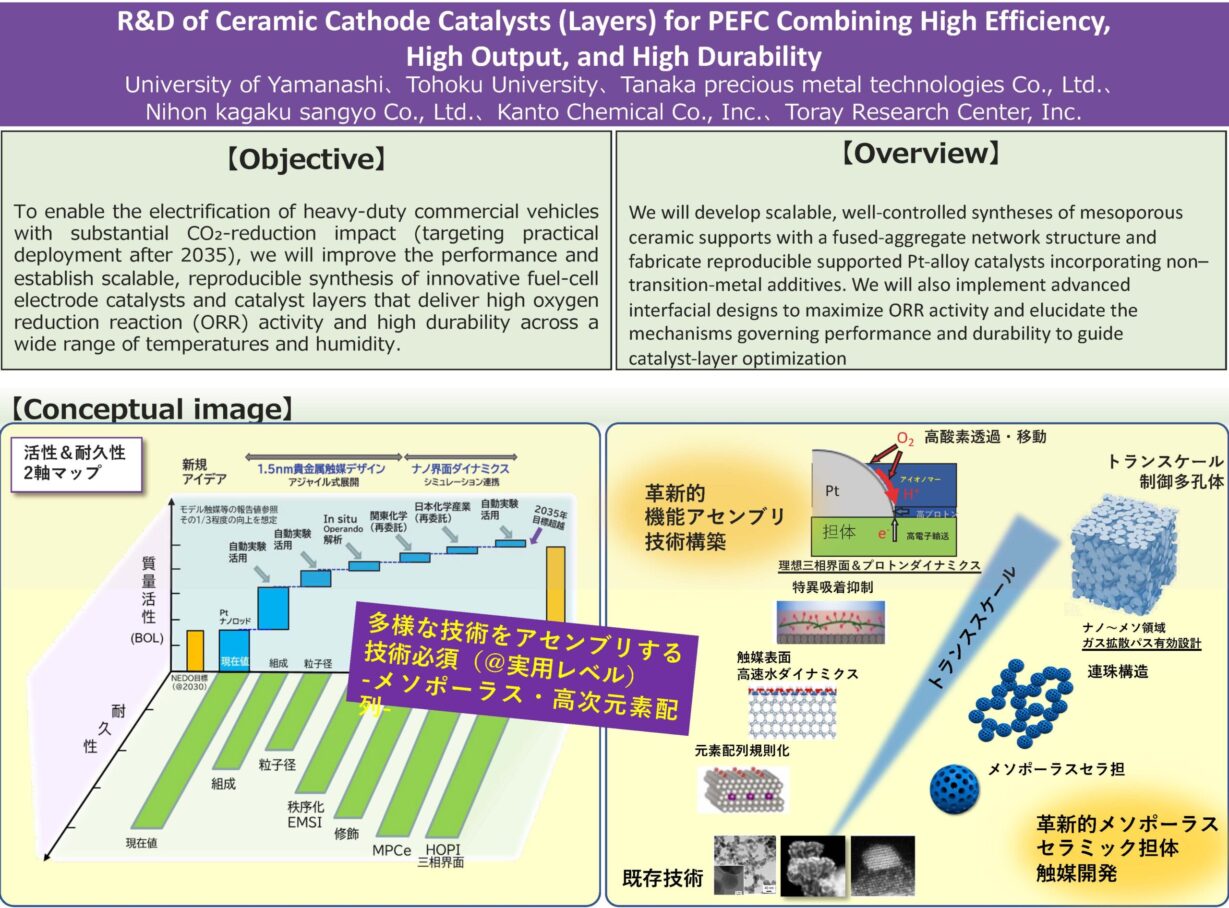
1)ADVANCED_ Cathode Catalyst「R&D of Ceramic Cathode Catalysts (Layers) for PEFC Combining High Efficiency, High Output, and High Durability」
To realize the targets of the NEDO Technology Development Roadmap, it is essential to develop new catalysts that achieve higher performance, greater durability, and lower cost in fuel cells. Our university has long-standing expertise in catalysts supported by high-output, high-durability, and high-efficiency ceramic materials. We are now advancing these materials into porous ceramic nanoparticles to further enhance performance while reducing costs. Using these particles as supports, we are designing catalysts loaded with highly active Pt-based nanoparticles. Furthermore, we use molecular dynamics simulations to analyze nanoscale mass transport and clarify the crucial role of the catalyst–ionomer interface in forming next-generation, high-performance cathode catalysts.
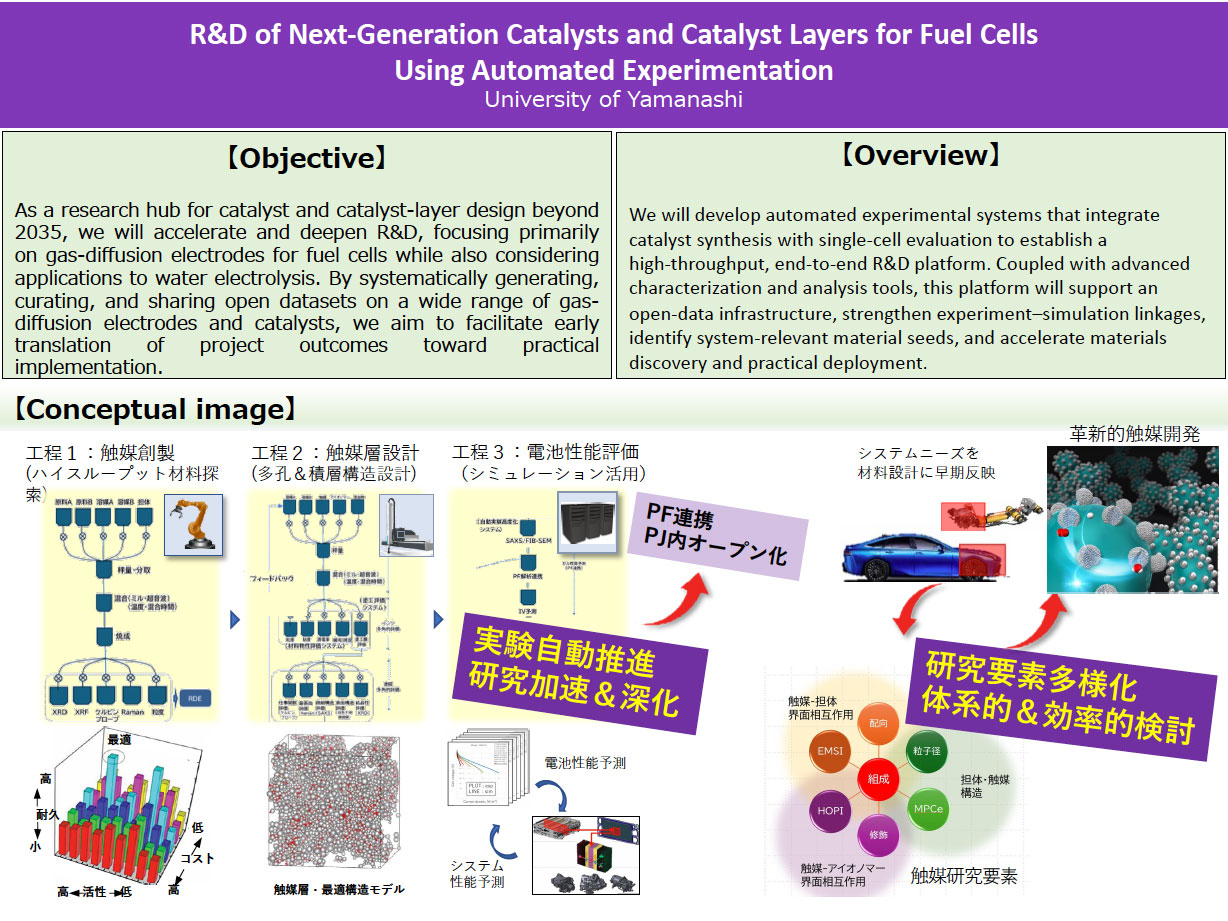
2)ADVANCED_ Automatic Catalyst Prototyping「R&D of Next-Generation Catalysts and Catalyst Layers for Fuel Cells Using Automated Experimentation」
Technological capabilities in advanced fields form the foundation of national industrial competitiveness, and Digital Transformation (DX) in R&D is essential for sustaining this edge. As fuel cell and hydrogen technologies involve physical material systems, automating experimental processes is a vital element of DX. Our university has been selected as a core institution to lead this NEDO-commissioned effort. We are constructing an integrated, automated platform for everything from material synthesis to power generation evaluation. This platform will be accessible to other research groups, and the data obtained will be shared openly to establish a global hub for advanced materials development and meet 2035 performance targets.
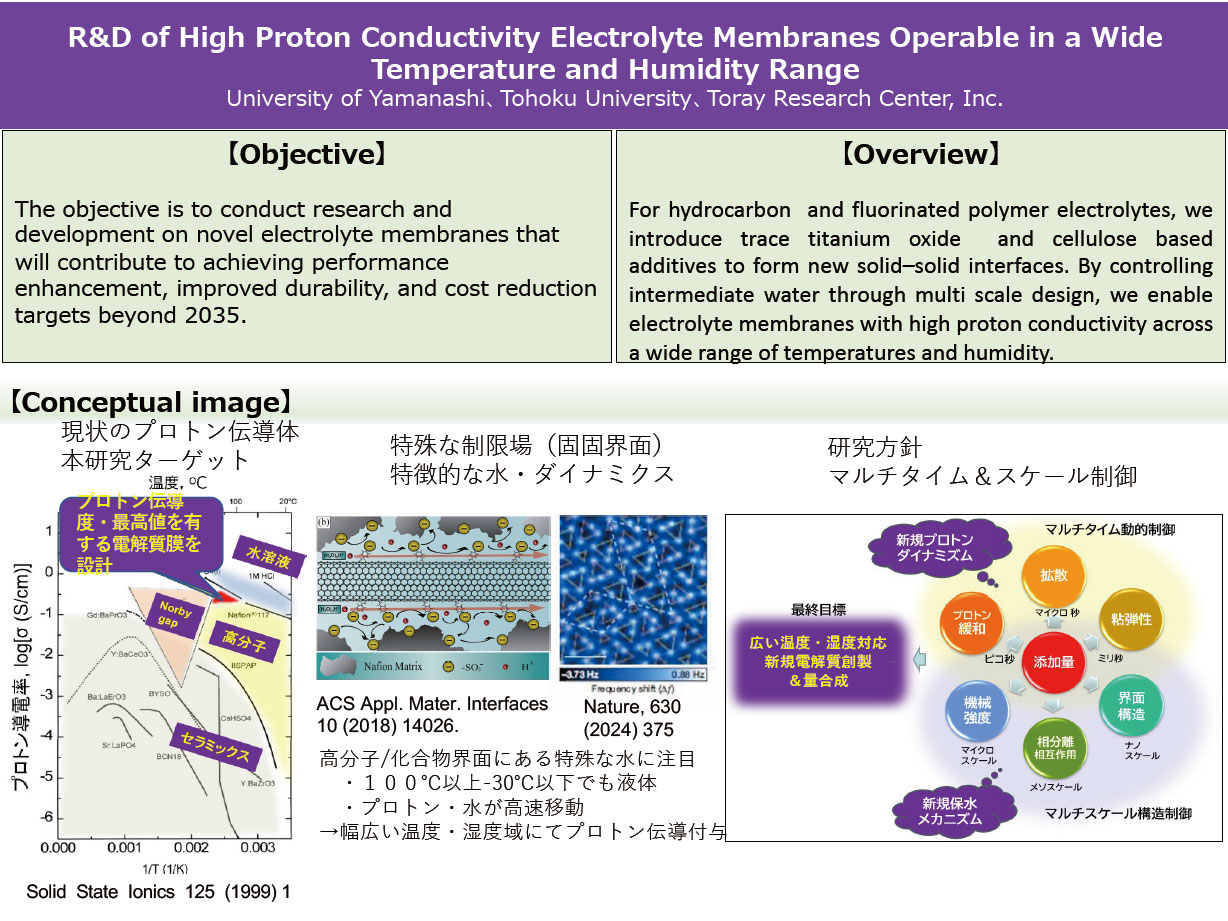
3)ADVANCED_ Membranes「R&D of High Proton Conductivity Electrolyte Membranes Operable in a Wide Temperature and Humidity Range」
To achieve roadmap goals, electrolyte membranes must maintain high proton conductivity and mechanical strength under diverse conditions. We are developing novel composite membranes by incorporating nanofibers and inorganic nanoparticles which are fused-aggegate network structure into hydrocarbon-based and fluorinated electrolytes. By using molecular dynamics simulations to optimize water behavior and material design, we aim to achieve the performance, durability, and cost targets required for 2035 and beyond.
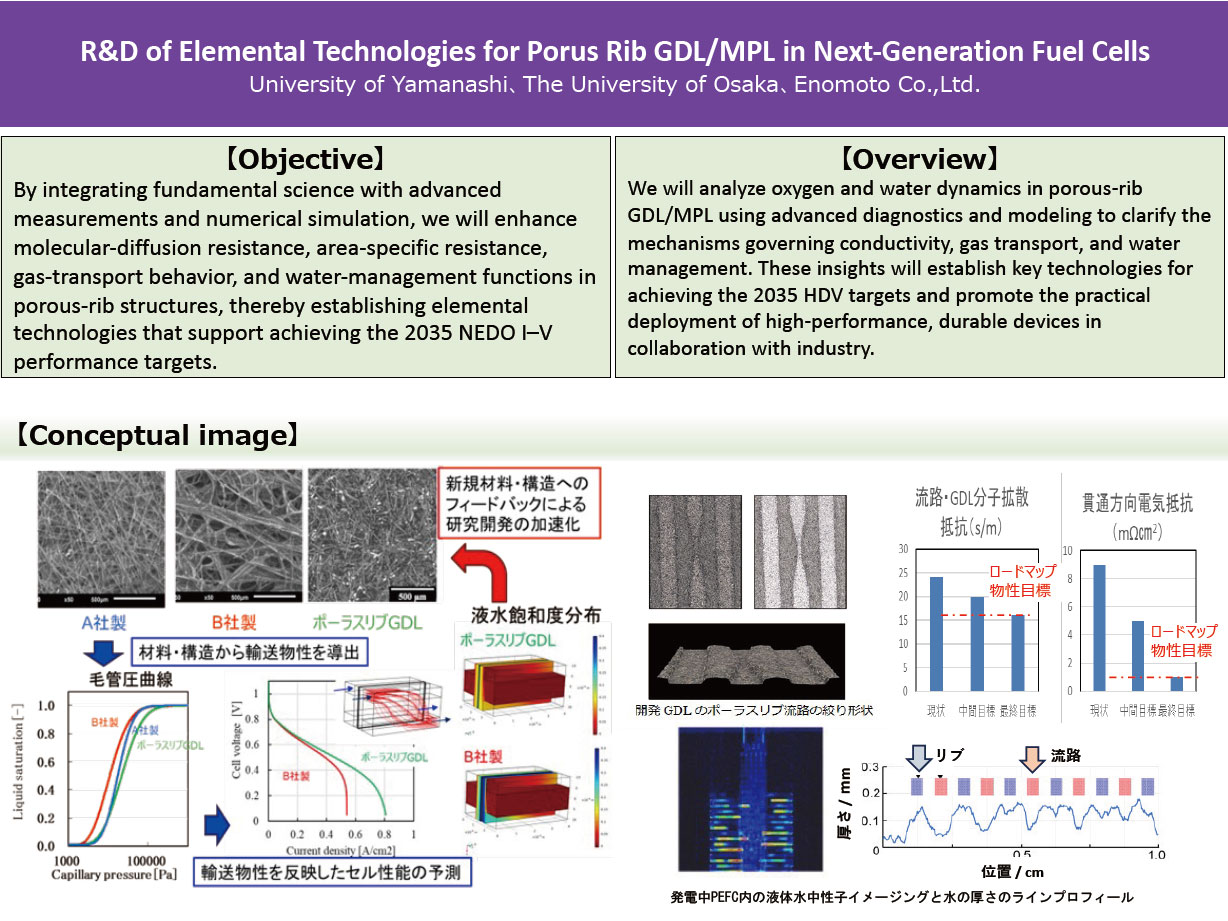
4)ADVANCED_ Porus Rib GDL「R&D of Elemental Technologies for Porus Rib GDL/MPL in Next-Generation Fuel Cells」
Gas Diffusion Layers (GDL) and Microporous Layers (MPL are critical for delivering reactants to the catalyst layer. We have proposed a unique cell structure that creates flow channels within the GDL, generating forced sub-rib gas flow to dramatically improve catalyst utilization. This technology can be fabricated simply and at low cost. In this project, we aim to enhance porous rib GDL/MPL technologies to meet 2035 targets through multifaceted analysis, including neutron and X-ray imaging and reaction-transport modeling—to establish key technologies for Heavy-Duty Vehicle (HDV) applications.
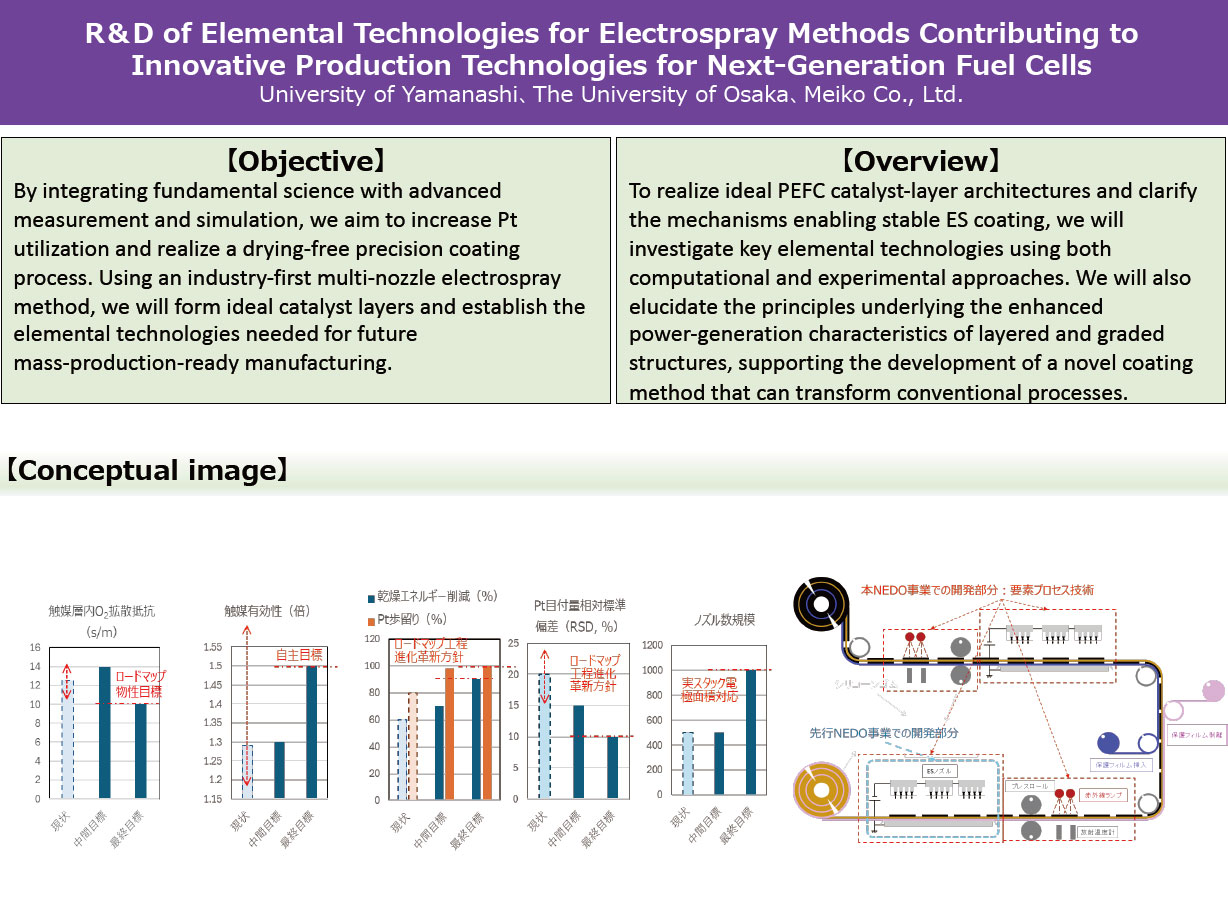
5)ospray Methods Contributing to Innovative Production Technologies for Next-Generation Fuel Cells」
To realize ideal catalyst layer structures, we are developing an industry-first multi-nozzle electrospray (ES) method that eliminates the conventional drying process. This innovative approach enables precision coating and gradient structure formation, maximizing platinum (Pt) effectiveness. By combining experimental analysis with computational science, we are clarifying the mechanisms of ES coating and ionomer crystallization to pave the way for future high-throughput mass production.
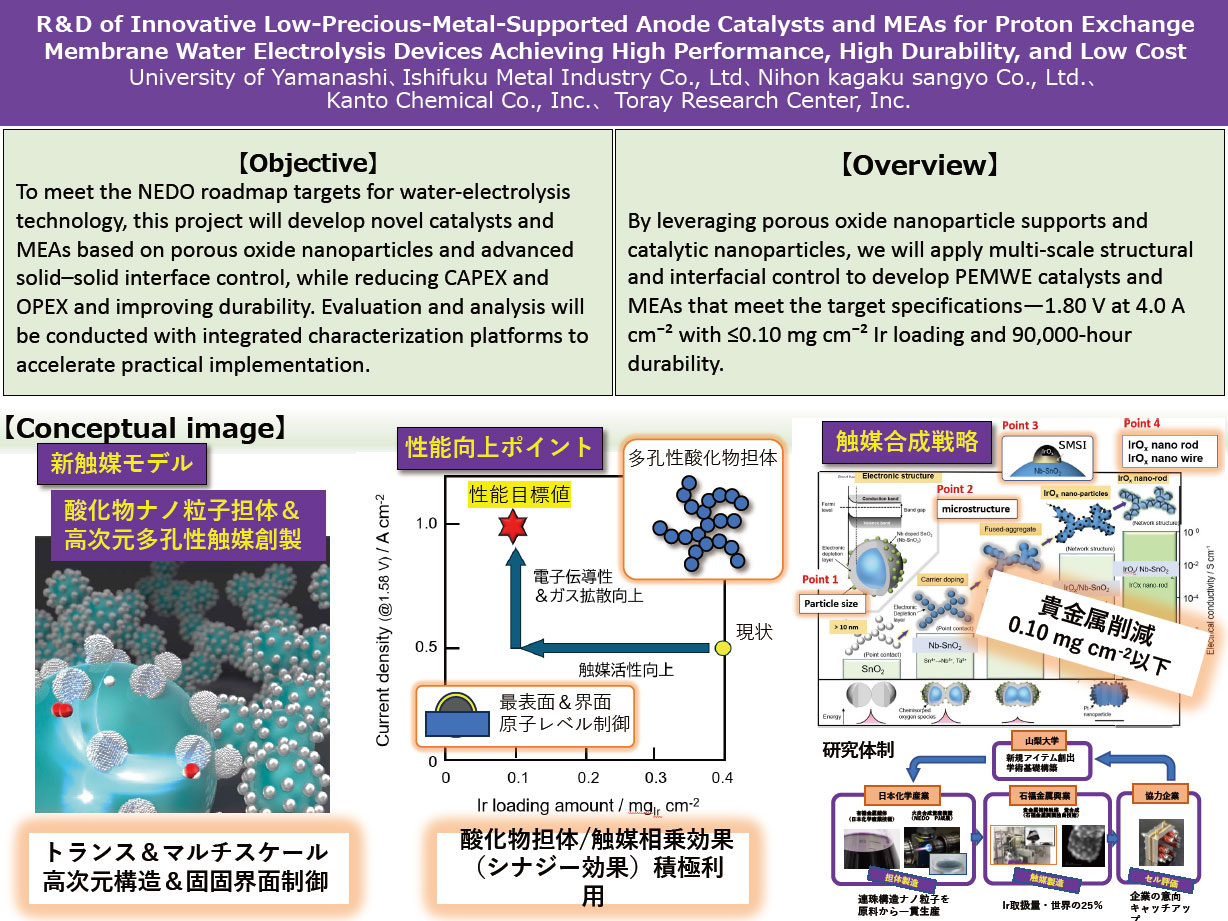
6)ADVANCED_PEMWE「R&D of Innovative Low-Precious-Metal-Supported Anode Catalysts and MEAs for Proton Exchange Membrane Water Electrolysis Devices Achieving High Performance, High Durability, and Low Cost」
Proton Exchange Membrane Water Electrolysis (PEMWE) is crucial for green hydrogen production. To overcome the high cost of iridium (Ir), we are developing catalysts with Ir nanoparticles on conductive ceramic supports which are fused-aggegate network structure. Our research spans different scales—from microstructure to interface design—to commercialize high-performance MEAs that meet 2035 technological standards with minimal precious metal usage.
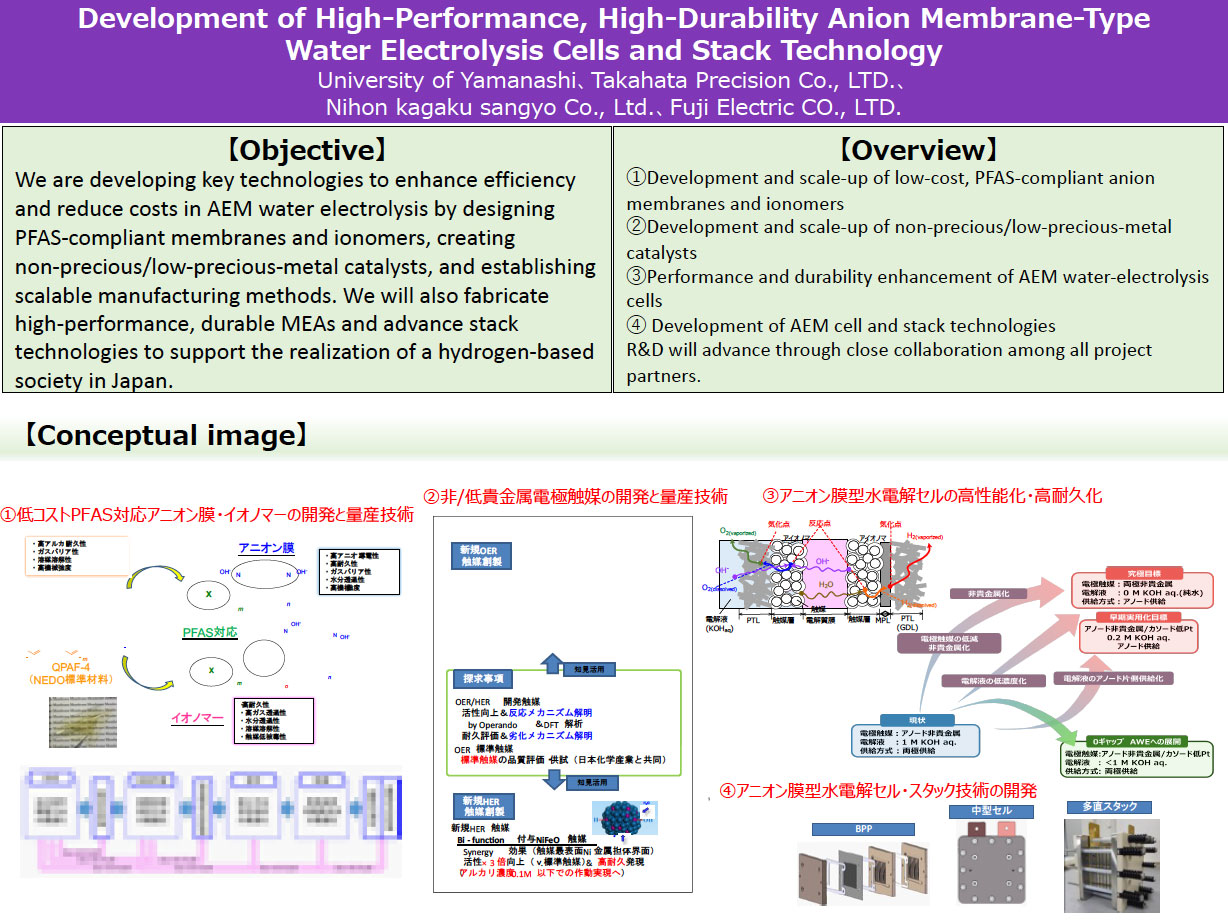
7)ADVANCED_AEMWE「Development of High-Performance, High-Durability Anion Membrane-Type Water Electrolysis Cells and Stack Technology」
Aiming to contribute to a hydrogen production cost of 18 yen/Nm³ by 2030, we are developing elemental technologies for Anion Exchange Membrane Water Electrolysis (AEMWE), including PFAS-compliant anion membranes, ionomers, and non-precious metal catalysts. Using an agile R&D framework, we share data across research institutions to rapidly optimize MEA fabrication and stack designs. This collaborative approach ensures we maximize research outcomes and realize a hydrogen-based society.
ECCEED’30-FC Project 2020~2024
The NEDO project Collaborative Industry-Academia-Government research and development Project for Solving Common Challenges Toward Dramatically Expanded Use of Fuel Cells and Related Equipment
「Research on innovative materials for high efficiency, high power and high durability PEFC」
ECCEED’40-FC Project 2020~2024
The NEDO project Collaborative Industry-Academia-Government research and development Project for Solving Common Challenges Toward Dramatically Expanded Use of Fuel Cells and Related Equipment
「Advanced material concepts for wide temperature and humidity operated PEFC」
SPer-FC Project 2015~2019
Strategic Development of PEFC Technologies for Practical Application
「Creation of materials concepts related to cell stacks /Concept creation of high output, high durability, high performance fuel cell materials」
Hi-PerFC Project 2008~2014
Strategic Development of PEFC Technologies for Practical Application
「Development of basic materials for high-performance cells that integrate deterioration mechanisms and nanotechnology」