

Strengthening research and development of water electrolysis and fuel cells to expand hydrogen utilization
In the Sixth Basic Energy Plan formulated in 2021, hydrogen was positioned as an essential secondary energy source for achieving carbon neutrality, and fuel cells were designated as key devices for decarbonization using hydrogen. In 2025, the New Energy and Industrial Technology Development Organization (NEDO) revised the “NEDO Fuel Cell and Hydrogen Technology Development Roadmap” (“NEDO Technology Map”), outlining technical goals for 2035 and beyond in areas such as HDV (heavy-duty vehicles).
This center was established in April 2008 with the aim of contributing to the widespread adoption of fuel cells, with the tremendous support of Yamanashi Prefecture and related government agencies.
From 2008 to 2014, we worked on projects commissioned by the Ministry of Economy, Trade and Industry and NEDO to gain insights into the mechanisms of reactions and degradation, and to integrate cutting-edge technologies such as nanotechnology.
From 2015 to 2019, the center achieved its goal of improving the overall performance of output, cost, and durability by approximately tenfold through projects commissioned by NEDO.
From 2020 to 2024, we worked on research and development of ceramic catalyst supports, ordered mesoporous carbon catalyst supports, hydrocarbon electrolyte membranes that combine chemical stability and mechanical strength, and ionomers with excellent gas permeability in projects commissioned by NEDO. Concurrently, we worked on NEDO-commissioned projects including “reduction of precious metal content in anode catalysts for proton exchange membrane-type water electrolysis devices,” “elemental research on anion exchange membrane-type alkaline water electrolysis cells,” “GDL-integrated flat separators,” and “electrostatic spray method.”
Currently, we are working on the following seven NEDO-commissioned projects that contribute to the realization of NEDO’s technology map goals. ① Next-generation catalysts and catalyst layers for fuel cells using automated experiments, ② Ceramic cathode catalysts (layers), ③ High proton conductivity electrolyte membranes and ionomers operable in a wide temperature and humidity range, ④ Elemental technologies related to electrostatic spray methods, ⑤ Elemental technologies related to porous rib GDL/MPL, ⑥ Innovative low-precious metal-loaded anode catalysts and MEAs for proton exchange membrane-type water electrolysis devices, ⑦ Catalysts, electrolytes, and MEAs for anion exchange membrane-type water electrolysis devices.
Our center will make full use of our talented researchers and world-class cutting-edge facilities to ensure that these research and development results are widely utilized by industry, thereby dramatically expanding the use of hydrogen and fuel cells. At the same time, we will actively engage in joint research between industry, academia, and government, as well as education from undergraduate to graduate school levels, to create cutting-edge research results and nurture researchers and engineers who will lead the field of green energy.
We look forward to your warm support and guidance.
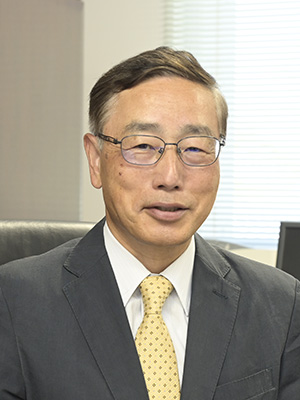
Akihiro Iiyama
Director, Hydrogen and Fuel Cell Nanomaterials Center
University of Yamanashi